Georgia insurance subrogation: questions and answers

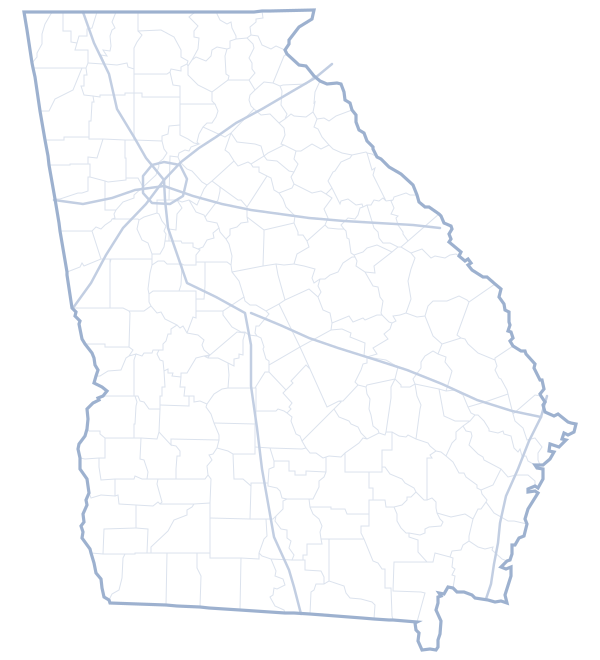
How subrogation works in Georgia, answered by a firm that has recovered subrogation claims for carriers in all 159 counties since 2005.

Questions

For letter recipients

I received a subrogation letter. What is it?

It means an insurance company paid a claim for damage that it contends you are responsible for, and our firm has been retained to recover that payment on the carrier’s behalf. It is a civil claim for money. It is not a criminal matter and not a traffic citation.

If you were in an accident and the other driver’s insurer paid for their repairs, that insurer has the right to recover from you what it paid. If you had liability insurance at the time, send us your carrier and policy information and we will deal with your insurer directly. If you were uninsured, the claim is against you personally, and we can usually discuss a payment arrangement.

The fastest way to resolve it is to call us. Payments can also be made online or by mail.

For carriers & letter recipients

What is insurance subrogation?

Subrogation is the right of an insurer that has paid a claim to step into its insured’s shoes and recover that payment from the party who caused the loss. It shifts the cost of a loss from the carrier that paid it to the person legally responsible for it.

Subrogation exists so that the party at fault, rather than the insurance company that happened to issue the policy, ultimately bears the cost of a loss. When a carrier pays to repair an insured’s vehicle or rebuild a fire-damaged home, that payment does not excuse the at-fault driver, the negligent contractor, or the maker of a defective product. The right to pursue that party passes to the insurer.

In Georgia, subrogation rights come from two places: the policy itself, which normally contains an express subrogation clause, and equity, which recognizes the right in appropriate circumstances even where the contract is silent. A subrogated insurer takes the claim as its insured held it. That means it inherits both the insured’s rights and any defenses the at-fault party could have raised against the insured.

For carriers

Does Georgia follow the made whole doctrine?

Yes, but its reach is limited. Georgia’s made whole doctrine holds that an insured must be fully compensated before its insurer recovers. The Supreme Court of Georgia has confined the rule to personal injury claims and to an insurer’s reimbursement for medical and similar benefits. It does not bar subrogation under a property policy that expressly grants subrogation rights.

Georgia adopted the made whole rule in Duncan v. Integon General Insurance Corp., 267 Ga. 646, 482 S.E.2d 325 (1997). The reasoning is that where either the insurer or the insured must go unpaid, the loss should fall on the insurer, which collected a premium to assume exactly that risk.

In Woodcraft by Macdonald, Inc. v. Georgia Casualty & Surety Co., 293 Ga. 9, 743 S.E.2d 373 (2013), the Supreme Court of Georgia held that the made whole doctrine does not apply to a commercial property insurance contract that expressly authorizes the insurer to pursue subrogation after paying its insured for property damage. The Court noted that the made whole rule had only been applied in Georgia to personal injury claims and to an insurer’s right to be reimbursed by its insured for medical or other benefits paid.

For property and automobile carriers, the policy language decides it. Check the subrogation clause before conceding a made whole objection on a first-party property claim.

For carriers

Can a health insurer subrogate against the at-fault driver in Georgia?

No. Under O.C.G.A. § 33-24-56.1, a benefit provider that paid medical expenses or disability benefits cannot pursue the at-fault party directly. It may only seek reimbursement out of the injured person’s own recovery, and only after that person has been fully compensated for all economic and non-economic losses.

O.C.G.A. § 33-24-56.1 governs benefit providers, a term defined broadly to include insurers, health maintenance organizations, health benefit plans, preferred provider organizations, and employee benefit plans that pay or reimburse health care expenses. Three rules matter most:

  1. No direct subrogation. Subrogation against the person at fault for medical expenses and disability payments is prohibited, and a liability carrier may not name a reimbursement-seeking insurer as a copayee on a settlement check or draft.
  2. Reimbursement only after full compensation. A benefit provider may recover from the injured party’s third-party recovery only if that recovery exceeds the sum of all economic and non-economic losses, and the reimbursement is reduced pro rata by the attorney’s fees and litigation expenses the injured party incurred.
  3. Notice runs both directions. The person asserting the third-party claim must notify any benefit provider it has reason to believe paid benefits, no later than ten days before a settlement is consummated or a trial begins, requesting an itemization of what the provider claims. Separately, a reimbursement claim is enforceable against the injured party only to the extent that person had actual notice of it before settlement or trial.

ERISA. Section 33-24-56.1 does not reach a self-funded plan governed by ERISA. Under FMC Corp. v. Holliday, 498 U.S. 52 (1990), ERISA preempts state anti-subrogation laws as applied to self-funded plans, so a ten-day letter sent to a self-funded plan will not defeat its reimbursement claim.

The statute governs health and disability benefit providers. It does not limit an insurer’s subrogation for property damage, and it is no bar to the automobile, property and fire recovery work described on our services page.

For carriers

How long does an insurer have to file a subrogation suit in Georgia?

Georgia allows four years for damage to real property under O.C.G.A. § 9-3-30 and four years for damage to personal property under § 9-3-31. Personal injury claims carry two years under § 9-3-33. The date the clock starts running is not always the date of the loss.

A negligence cause of action accrues when the negligent act combines with a resulting injury, and in construction and product cases Georgia courts have measured that from the negligent act rather than from the date the damage became apparent.

In Stamschror v. Allstate Insurance Co., 600 S.E.2d 751 (Ga. App. 2004), a home was substantially completed in August 1994 and burned in December 1998. The carrier filed suit in April 2001, within four years of the fire but more than four years after completion, and the claim was dismissed as untimely. Howard v. McFarland, 515 S.E.2d 629 (Ga. App. 1999), states the underlying rule that ignorance of the facts constituting a cause of action does not prevent the limitation period from running.

Georgia also imposes an eight-year statute of repose on actions arising out of improvements to real property, measured from substantial completion, under O.C.G.A. § 9-3-51.

Running the other direction, O.C.G.A. § 9-3-99 tolls the limitation period for a tort action brought by the victim of an alleged crime, from the date of the crime until the prosecution becomes final or is otherwise terminated, up to six years. On a claim arising from a DUI, a hit and run, or vehicular homicide, a file that looks time-barred on its face may not be.

For carriers

Whose name does a Georgia subrogation lawsuit get filed in?

It depends on the paperwork. Under O.C.G.A. § 9-2-21(a), an action for injury to property is brought in the name of the person legally interested in the property when the injury occurred, or in the name of that person’s assignee. Under an assignment or subrogation agreement the insurer sues in its own name; under a loan receipt it may sue in the insured’s name.

This trips up carriers that handle claims in several states, because the answer turns on which document controls rather than on a single fixed rule.

  • If an assignment is followed by a loan agreement, the assignment controls. Alta Refrigeration, Inc. v. AmeriCold Logistics, LLC, 688 S.E.2d 658 (Ga. Ct. App. 2009).
  • A loan agreement is also ineffective if it is preceded by policy terms that themselves work an assignment. U.S.F. & G. v. J. I. Case Co., 432 S.E.2d 654 (Ga. Ct. App. 1993).
  • Policy conditions that do not expressly speak of transfers or assignments of causes of action do not work an assignment. Allstate Ins. Co. v. Welch, 576 S.E.2d 57 (Ga. Ct. App. 2003).
  • An insured may accept payment from its own insurer and assign its claims against third parties, but the language of the assignment must demonstrate an intent to transfer the right of action. Bowen v. Waters, 316 S.E.2d 497 (Ga. Ct. App. 1984).
  • Where the insured assigns any and all causes of action against the tortfeasor, the insurer is the proper party. Parker Plumbing & Heating Co. v. Kurtz, 165 S.E.2d 729 (Ga. 1969).

For carriers

What can a Georgia subrogation claim recover?

A subrogated carrier can generally pursue what its insured could have pursued: the cost of repair or the actual cash value of a total loss, loss of use, diminished value on a repaired vehicle, and the insured’s deductible.

  • Repair cost or actual cash value. The measure of damages for injury to personal property in Georgia is the difference between its market value before and after the tortious act.
  • Loss of use. Measured by the rental value of a substitute. Georgia requires an actual loss, so a hypothetical rental figure where no substitute was needed will not carry the element.
  • Diminished value. Georgia recognizes that a properly repaired vehicle can still be worth less than one that was never wrecked. State Farm Mutual Automobile Insurance Co. v. Mabry, 274 Ga. 498, 556 S.E.2d 114 (2001), decided in the first-party context, required insurers to assess diminution in value on physical damage claims.
  • The insured’s deductible. Carriers routinely pursue the deductible alongside their own payment and return it to the insured on recovery, which is both sound practice and good for policyholder retention.

For carriers

What is inter-company arbitration?

Inter-company arbitration is a private forum where two insurers resolve a subrogation dispute between themselves under agreed rules instead of filing suit. It is generally faster and less expensive than litigation, and it is available when both carriers are signatories to the applicable arbitration agreement.

Where the at-fault party is insured by a carrier that participates in inter-company arbitration, liability and damages are decided by an arbitrator rather than a Georgia court.

Litigation remains the right path when the responsible party is uninsured, when the opposing carrier is not a signatory, when the amount at issue exceeds the forum’s limits, or when a coverage question needs a judicial answer. We handle both: see our services.

For carriers & letter recipients

What happens if the at-fault party has no insurance?

An uninsured at-fault party is still personally liable. A Georgia carrier can sue, take judgment, and enforce it through property liens, bank and wage garnishments, income deduction orders, and suspension of the debtor’s driver’s license for an unsatisfied judgment under O.C.G.A. § 40-9-61.

We keep collecting after the judgment. Under O.C.G.A. § 40-9-61, on receipt of a certified copy of an unsatisfied judgment arising from a motor vehicle accident, the Department suspends the driver’s license or operating privilege of the person the judgment was entered against, and it stays suspended until the judgment is satisfied or stayed. The statute also allows the judgment creditor to consent in writing to let the debtor keep the license, a consent that can later be revoked.

A debtor who needs to drive will usually agree to a payment plan and keep to it. Our services page describes the post-judgment tools we use: property liens (FIFAs), bank and wage garnishments, income deduction orders, and license suspension.

Authorities cited on this page

The Georgia statutes and decisions referenced above, grouped for reference.

Statutes

  • O.C.G.A. § 33-24-56.1: reimbursement of medical expense and disability benefit providers; subrogation prohibited; notice
  • O.C.G.A. § 9-2-21(a): parties to actions for injury to property
  • O.C.G.A. §§ 9-3-30, 9-3-31, 9-3-33: limitation periods for realty, personalty, and personal injury
  • O.C.G.A. § 9-3-51: statute of repose, improvements to real property
  • O.C.G.A. § 9-3-99: tolling while a criminal prosecution is pending
  • O.C.G.A. § 40-9-61: license suspension for nonpayment of judgment

Cases

  • Duncan v. Integon General Insurance Corp., 267 Ga. 646, 482 S.E.2d 325 (1997)
  • Woodcraft by Macdonald, Inc. v. Georgia Casualty & Surety Co., 293 Ga. 9, 743 S.E.2d 373 (2013)
  • FMC Corp. v. Holliday, 498 U.S. 52 (1990)
  • Stamschror v. Allstate Insurance Co., 600 S.E.2d 751 (Ga. App. 2004)
  • Howard v. McFarland, 515 S.E.2d 629 (Ga. App. 1999)
  • Alta Refrigeration, Inc. v. AmeriCold Logistics, LLC, 688 S.E.2d 658 (Ga. Ct. App. 2009)
  • U.S.F. & G. v. J. I. Case Co., 432 S.E.2d 654 (Ga. Ct. App. 1993)
  • Allstate Ins. Co. v. Welch, 576 S.E.2d 57 (Ga. Ct. App. 2003)
  • Bowen v. Waters, 316 S.E.2d 497 (Ga. Ct. App. 1984)
  • Parker Plumbing & Heating Co. v. Kurtz, 165 S.E.2d 729 (Ga. 1969)
  • State Farm Mutual Automobile Insurance Co. v. Mabry, 274 Ga. 498, 556 S.E.2d 114 (2001)

This page provides general information about Georgia insurance subrogation law. It is not legal advice, and reading it does not create an attorney-client relationship with Boutwell and Associates, LLC.

Statutes are amended and decisions are overruled. Confirm the current state of the law, and consult an attorney about the specific facts of your claim before relying on anything described here.